Points of no return, 2025
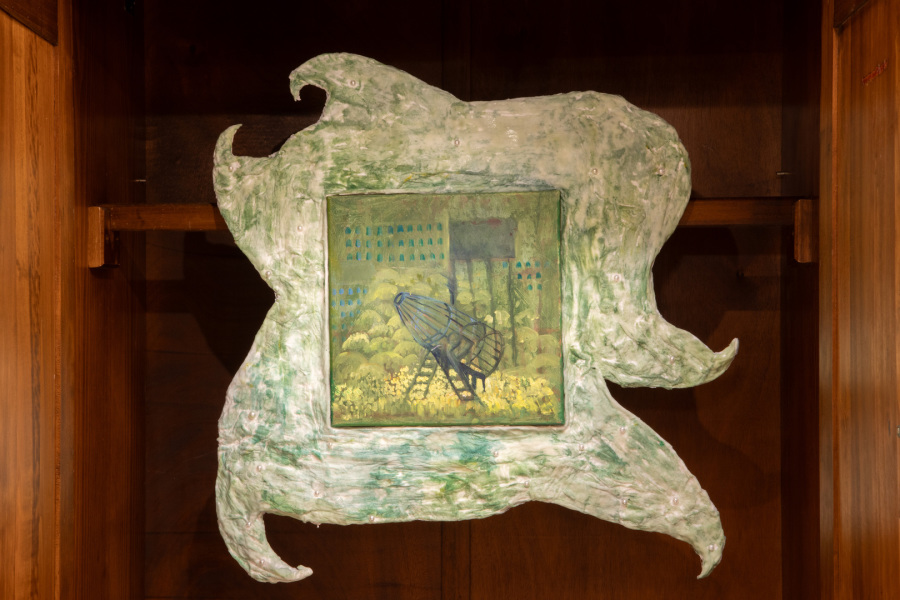
Installation view, Teaser Venice
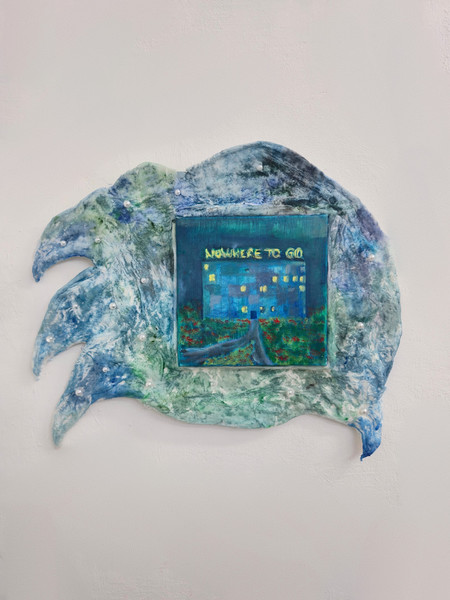
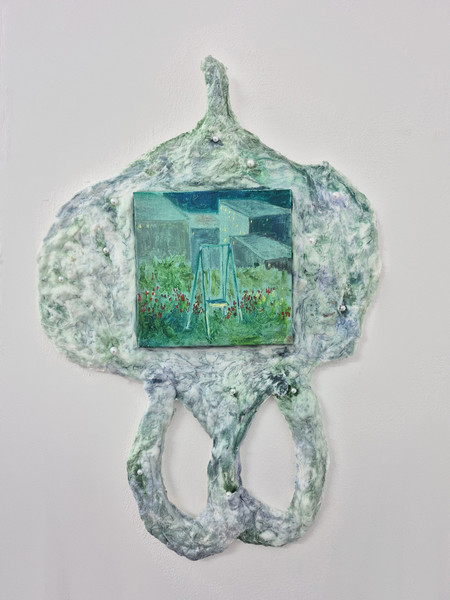
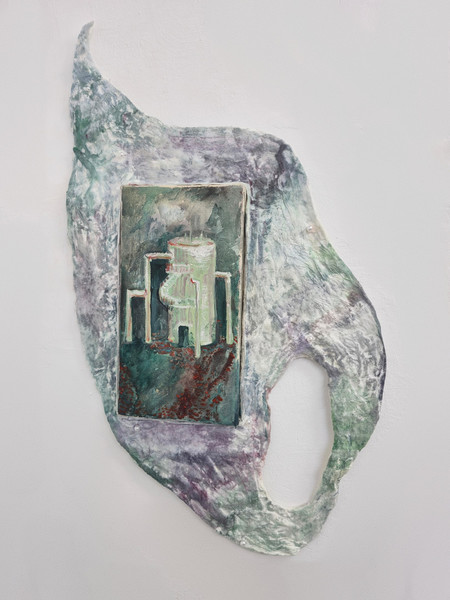
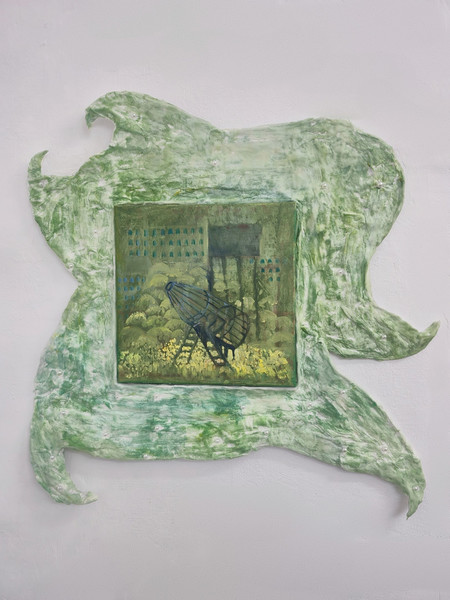
In
Points of No Return (2025), Anna Bochkova presents a series of paintings inspired by the popular song Grass by the Home, widely known during the era of the space race. The song reflects on the
transformation of the private and the familiar once the Earth is viewed from space, a shift that serves as a conceptual point of departure for the series. Bochkova approaches the planet itself as a
living archive—one that holds both the imprints of everyday life and the vast projections of cosmic imagination.
Across the canvases, Bochkova depicts post-Soviet playgrounds and panel housing blocks whose architectural forms echo space rockets and visions of cosmic travel. These structures belong to a shared
collective memory: attempts to materialize utopian futures within the most ordinary settings. At the same time, they are grounded in the artist’s personal recollections, shaped by her upbringing in
steppe and semi-desert regions where feelings of alienation and belonging existed in constant tension.
The paintings move between reality, memory, and dream, producing ambiguous spaces in which multiple temporalities coexist. These spaces are not stable; they dissolve and stretch under political
pressure, becoming emotionally and psychologically more distant than the stars themselves. Through the lens of migration theory, Bochkova reflects on how political systems, borders, and historical
ruptures fracture spatial continuity, turning familiar landscapes into sites of estrangement. Migration here is not only a physical displacement but also a temporal and affective one, in which home
becomes unreachable even when it remains geographically present.
The series reflects on fragile points of no return in a rapidly transforming world—moments when private memory collapses into collective history, when utopian ideals erode into ruins, and when
nostalgia merges with speculative thought. Political forces accelerate these ruptures, amplifying the distance between individuals and their environments, and rendering everyday spaces as relics of
interrupted futures. In this sense, the imagined cosmos and the lived landscape mirror one another: both become territories shaped by longing, loss, and projection.
Playground rockets and housing blocks appear as both monuments and remnants—intimate archives of a society once oriented toward the cosmos, and evidence of how landscapes absorb the consequences of
political and social upheaval. Whether encountered individually or as a constellation, the paintings form layered terrains where memory, migration, ecology, and speculation intersect. Together, they
invite viewers to consider how such fragile archives—both personal and planetary—might be cared for before they dissolve entirely into alienation.
 Druckversion